
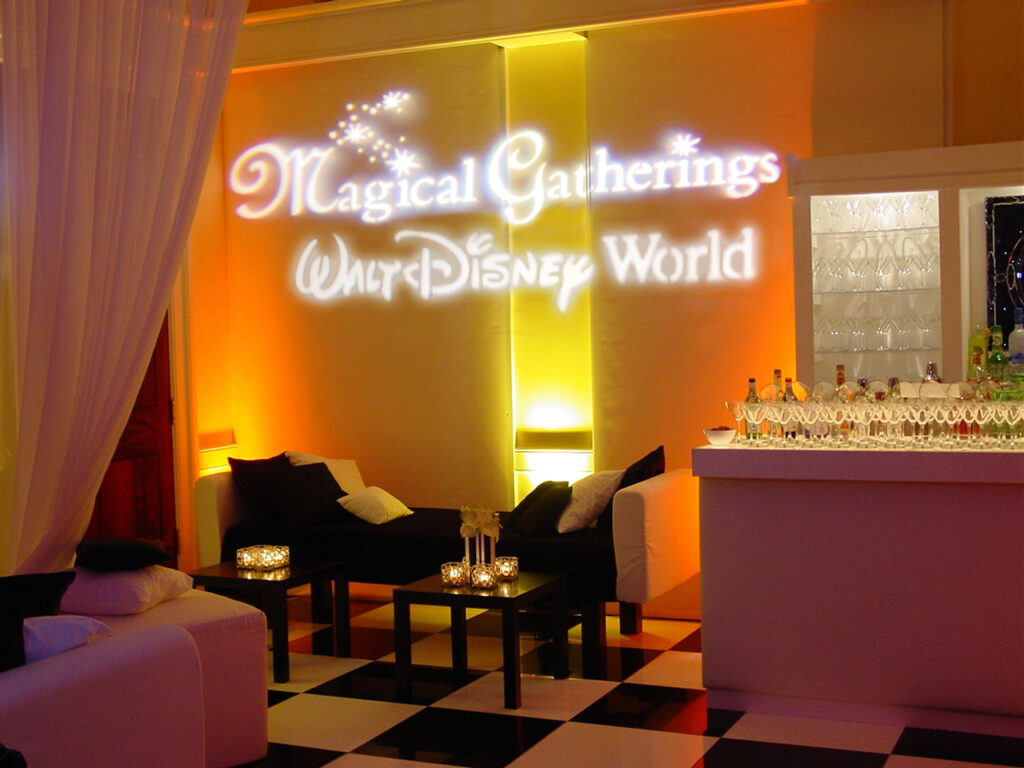
Ask a DC host to describe great event lighting, and they’ll picture a wash of color around the room. That’s uplighting, quietly doing its job in the background. Gobo lighting is the layer most people don’t notice until they see it: a monogram glowing across the dance floor, a company logo lit up behind the stage, a pattern rippling over a ballroom wall. It’s a small detail with an outsized effect, the moment a guest looks around and realizes this event was designed for them, not just decorated.
What Gobo Lighting Actually Does
A gobo is a shaped template inside a lighting fixture that projects an image instead of a plain wash of color. At an NYX event, that means a monogram over the dance floor during a milestone celebration, a company logo behind the podium at a keynote, or a shifting texture that lifts the room’s energy the moment the dance set starts. One fixture does the work that used to take several: a projector, a sign, a decor piece.
Glass templates hold the crispest detail, sharp text, clean logos, fine gradients, which is why NYX reaches for glass whenever a monogram or brand mark needs to read clearly across a room.
Gobo Lighting Moves With the Room
A gobo fixture runs through the same lighting controls as the rest of the room’s intelligent lighting, so NYX’s entertainment team can shift a pattern, change a color, or move a projection in real time, right alongside everything else happening on the floor. It’s part of how the room changes across the night: a monogram during cocktail hour becomes a moving texture the second the dance set starts, no extra fixture, no pause in the action, just the room shifting into an atmosphere that encourages a packed dance floor.
The Steady Layer Underneath: Uplighting
Gobo and intelligent lighting bring the movement and detail. Uplighting brings the steady layer underneath: a single color washed along the room’s walls and architecture that holds constant through dinner and speeches, adding instant depth and warmth for one of the most cost-effective ways to transform how a room feels. We’ve written before about the case for uplighting; the short version: it’s the foundation the rest of the room’s lighting adds to, not a substitute for it.
A DC Event, Start to Finish
Picture a corporate gala: the stage backdrop opens with the client’s logo in a crisp gobo projection, uplighting warms the room through a keynote, and the moment the entertainment team calls the dance set, the same fixtures shift into moving patterns and a floor projection- just a cue, no new equipment. A milestone celebration works the same way: a monogram glowing on the floor during cocktail hour, then texture and movement once the party opens up- the same layered approach we’ve used transforming country club ballrooms across the DMV.
That’s the advantage of working with one entertainment team that plans the whole sequence from the first venue walk-through, not separate vendors patching pieces together.
Explore the full lighting effects lineup to see how it comes together for your event
FAQ
What does gobo lighting actually add to an event?
It projects a monogram, company logo, or pattern instead of a plain wash of color, so the room reads as designed for that specific event, not just lit.
Does gobo lighting work for corporate events, not just weddings and mitzvahs?
Yes. A logo lit up behind the stage during a keynote is one of the most common corporate uses, and it can shift into a different pattern the moment the entertainment portion starts.
Do we need extra equipment for gobo lighting, or does it work with what we’re already booking?
It runs through the same lighting system as the rest of the room, so the entertainment team can shift a gobo pattern in real time right alongside everything else, no extra fixture required.
How does gobo lighting work with uplighting?
Uplighting sets the steady color around the room. Gobo lighting adds the movement and detail on top of that: a monogram, a logo, a shifting texture, so the two work together as one lighting plan for the night.
How does NYX decide where to place gobo lighting for our venue?
Placement comes out of the venue walk-through, where ceiling height, wall material, and where the stage or dance floor sits in the room all factor in, alongside the rest of the lighting plan for the space.